
Finalverse Earth · v0.3 public preview
The planet.
In context.
An open spatial intelligence platform for exploring geographic evidence, understanding change over time and building AI applications around the real world.
The v0.3 public preview is live. Explore the bundled reference sources without signing in, or run the open-source workspace locally. This is a browser application; no Finalverse World account or MutSea server is required.
Space × time × evidence
See where.
Understand when.
Geometry, observations and sources in one workspace.
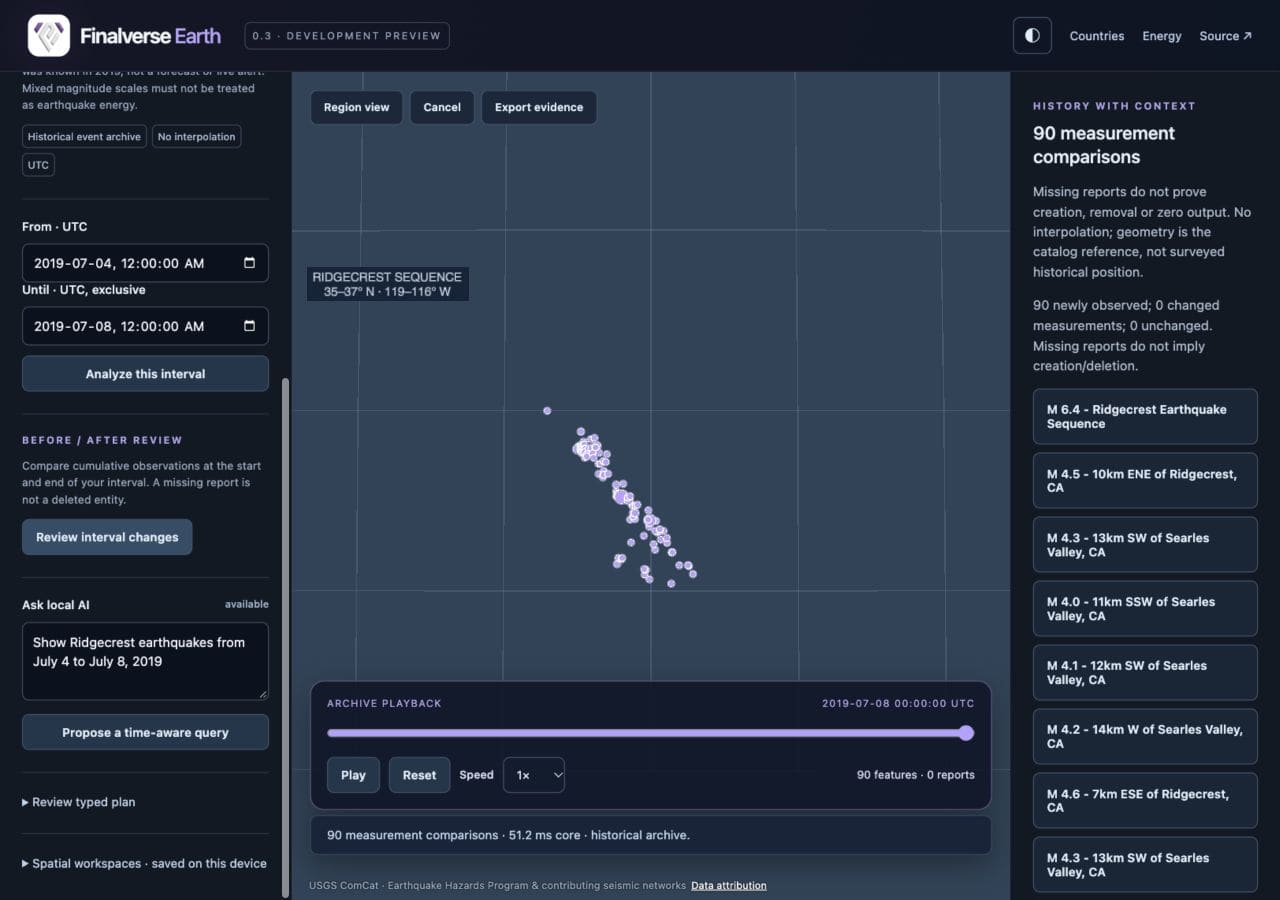
A question becomes an inspectable analysis
Start with Montréal. Find renewable-energy facilities within 100 kilometres. Inspect the original facility, ellipsoidal distance and source attribution. Export the query, evidence and execution receipt, or save the view on your device.
Then explore the July 2019 Ridgecrest earthquake archive. Scrub the UTC timeline, play the recorded sequence and compare available observations. Missing measurements stay missing; the platform does not invent a trend.
Spatial intelligence, with a clear method
- Explore: an independent 3D globe, geographic search, source layers and feature inspection.
- Analyze: distance, containment, intersection, buffers and bounded spatial queries.
- Understand time: historical intervals, snapshots, reporting coverage and before/after review.
- Keep your work: local workspaces with portable JSON export and dataset-version checks.
AI proposes. Evidence answers.
Optional local inference translates a question into a typed plan. You review it before deterministic tools execute. Models cannot run arbitrary SQL or invent map features. The default public configuration works without an AI key and does not expose a hosted model service.
Real sources. Honest limitations.
The reference collection includes Natural Earth geography, WRI’s archival Canadian power-facility catalog and a pinned USGS earthquake sequence. Facility capacity is not electricity output. The Canadian source has no populated annual generation reports. The earthquake sequence is an acquired historical catalog, not a live hazard service or a reconstruction of everything known at the time.
A foundation for spatial applications
Energy research, geographic education, infrastructure exploration and historical data analysis are starting points. A headless core, typed plans, HTTP API and JavaScript/TypeScript/Python clients let developers build independent applications. Optional PostgreSQL/PostGIS preserves dataset ownership and access policies.
Versioned layer-provider contracts are implemented; a third-party application ecosystem, streaming and collaborative workspaces are future milestones. Finalverse World and MutSea integration are optional directions, not dependencies of Earth.
Try the public preview
Explore online without an account. Developers can download the prebuilt browser + Node API bundle from GitHub, with checksums and local setup instructions. It is separate from the native Finalverse World viewer.
Open, inspectable and extensible
Finalverse Earth builds on the maintained Finalverse God’s Eye View foundation and CesiumJS, preserving upstream notices. Each dataset and service has its own terms. Source attribution travels with the analysis.